
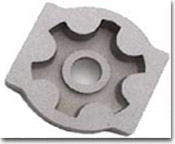
 Casting process enjoys certain advantages vis-a-vis other shaping processes such as forging, welding, stamping, rolling, extruding, etc. The reasons for the success of the casting process are:
- Owing to physical properties, some metals can only be cast since they cannot be re-modelled into bars, rods, plates or other shapes.
- It's a process highly adaptable to the requirements of mass production. Large numbers of a given casting can be produced quickly. For example; in the automotive industry there is massive production of cast engine blocks and transmission cases.
- Certain light metal alloys because of their respective strength and weakness, can be produced only as castings.
- Shows excellent bearing qualities.
Casting Vs Other processes It is fact that in some cases, the casting process must give way to other methods of manufacture, where they may be more efficient. For example, forging helps developing fiber strength and toughness in steel, machining produces smooth surfaces and dimensional accuracy not obtainable otherwise, welding provides a easy way of fabricating wrought or cast products into complex structures while stamping produce lightweight sheet metal parts.
Casting vs Forging: It should be recognized that castings and forgings start from very similar beginnings and castings can have some very distinct advantages over other product forms, including forgings.
Some of the key Advantages of Casting over Forging can be with respect to the following:- Design flexibility
- High production rate
- Large and complex parts
- Requires close process control and monitoring
- Shrinkage porosity may occur
- Metallic projections
- Cracks, hot tearing, coldshuts
- Laps, oxides
- Misruns, insufficient volume
- Inclusions