
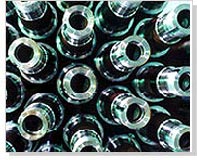
 A form of iron, steel contains less carbon than cast iron, but considerably more than wrought iron. The carbon content is from 0.03 to 1.7 percent. Basic carbon steels are alloyed with other elements, such as chromium and nickel, to increase certain physical properties of the metal. Steel can be machined, welded, and forged, all to varying degrees, depending on the type of steel.
Steel Alloy is used to make nails, rivets, gears, structural steel, roles, desks, hoods, fenders, chisels, hammers, etc.
Properties of Steel AlloysSteel has tensile strength of 45,000 psi (310,275 kPa) for low-carbon steel, 80,000 psi (551,600 kPa) for medium-carbon steel, 99,000 psi (692,605 kPa) for high-carbon steel, and 150,000 psi (1,034,250 kPa) for alloyed steel; and a melting point of 2800° F (1538°C).
Types of Steel Alloys Medium-carbon steelMedium-carbon steel contains carbon ranging from 0.30 to 0.50 percent. This steel may be heat-treated after fabrication. It is used for general machining and forging of parts that require surface hardness and strength. It is made in bar form in the cold-rolled or the normalized and annealed condition. During welding, the weld zone will become hardened if cooled rapidly and must be stress-relieved after welding.
High-carbon steelHigh-carbon steel contains carbon ranging from 0.50 to 0.90 percent. This steel is used for the manufacture of drills, taps, dies, springs, and other machine tools and hand tools that are heat treated after fabrication to develop the hard structure necessary to withstand high shear stress and wear. It is manufactured in bar, sheet, and wire forms, and in the annealed or normalized condition in order to be suitable for machining before heat treatment. This steel is difficult to weld because of the hardening effect of heat at the welded joint.
High carbon tool steelHigh carbon tool steel, also known as tool steel, contents carbon ranging from 0.90 to 1.55 percent. It is used to manufacture of chisels, shear blades, cutters, large taps, wood-turning tools, blacksmith's tools, razors, and similar parts where high hardness is required to maintain a sharp cutting edge. It is difficult to weld due to the high carbon content. A spark test shows a moderately large volume of white sparks having many fine, repeating bursts.
Cast steelWelding is difficult on steel castings containing over 0.30 percent carbon and 0.20 percent silicon. Alloy steel castings containing nickel, molybdenum, or both of these metals, are easily welded if the carbon content is low. Those containing chromium or vanadium are more difficult to weld. Since manganese steel is nearly always used in the form of castings, it is also considered with cast steel. Its high resistance to wear is its most valuable property.
Alloy SteelAlloy steel can easily be recognized by its use. Various alloy steels are used in the manufacture of defense equipment. These alloys have greater strength and durability compared to carbon steel. Manganese steel is a special alloy steel that is always used in the cast condition. Most commonly used elements used in alloy steel are nickel, chromium, vanadium, tungsten, molybdenum, and silicon.
- Chromium is added to carbon steels to enhance strength, corrosion resistance, and shock resistance. It brings high strength with little loss in ductility.
- Nickel is used to increase the toughness, strength, and ductility of steels, and lower the hardening temperatures.
- Manganese increases toughness, wear resistance, easier hot rolling, and forging. An increase in manganese content decreases the weldability of steel.
- Molybdenum is used as an alloying element that increases hardenability. The impact fatigue property of the steel is improved with up to 0.60 percent molybdenum. Above 0.60 percent molybdenum, the impact fatigue property is impaired. Wear resistance is improved with molybdenum content above 0.75 percent.
- Titanium and columbium (niobium) are added as additional alloying agents corrosion resistant steels. It helps resistance to intergranular corrosion after the metal is subjected to high temperatures for long time.
- Tungsten is used as an alloying element in tool steel. It produces a fine, dense grain when used in small quantities. But if used in larger quantities (from 17 to 20 percent) and in combination with other alloys, it produces a steel that retains its hardness at high temperatures.
- Vanadium is added to control grain size. It results in increased hardenability and causes marked secondary hardness, yet resists tempering.
- Silicon is used to steel to get greater strength and corrosion resistance. It is often used in combination with manganese to obtain a strong, tough steel. High speed tool steels are usually special alloy compositions designed for cutting tools. The carbon content ranges from 0.70 to 0.80 percent. These alloys can only be weld by using the furnace induction method.
Steel Castings
Steel casting is a type of ferrous investment casting that are made out of carbon alloy and stainless steels. During the process of steel casting, free-flowing liquid steel is given shape using of molds. Steel castings can be used to produce small, complex, or hard-to-machine shapes, thereby eliminating the assembly, welding, and other finishing requirements.
Steel castings are used in various industrial applications, including - construction, energy, transportation, general industry, and marine. As steel is stronger than cast iron, wrought iron, and malleable iron, steel castings are generally used in the production of parts, which must endure wear, shocks, or heavy loads. Steel castings can be produced using carbon steel, low and high alloy steel, low temperature steel, heat resistant steel, and stainless steel.
What to look for?Steel CastingWhile selecting steel castings, the important factors to be considered are the design, material and testing. When buying steel castings, it is essential to identify the type of steel, which will be used to produce the part. Steel castings are generally ordered to ASTM requirements.